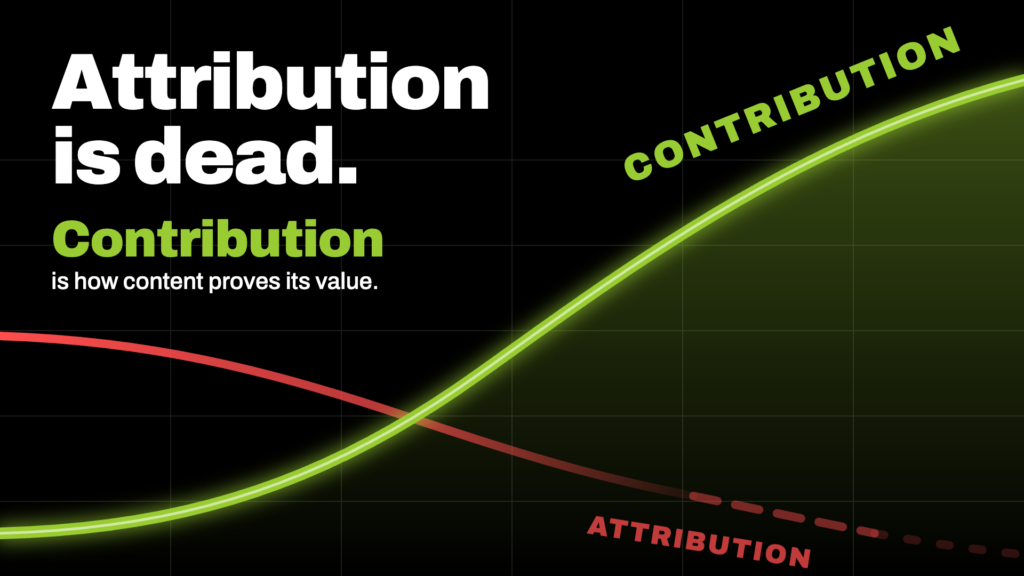

Based on my keynote at GPeC 2026 in Bucharest, Romania.
For 15 years I chased one word: Attribution. As a content marketer working in Marketing operations and Sales operations, I tracked the UTM codes and the cookies. I built the spreadsheets and lived inside Salesforce, HubSpot, Marketo, Eloqua, and Pardot, all in an effort to prove the value of content marketing.
I got pretty good at it. Companies in different countries brought me in to train their teams on how to track attribution and to show the value of marketing efforts. I even had a long-running talk that felt clever at the time. It was called “Digital Marketing: Click to Close.” That title did not age well.
Why attribution reporting stopped working
The internet gave digital marketers a gift. We believed we could track everything. Then the signals we depended on went dark, one by one. Google encrypted search keyword data, and the keywords that brought visitors to our sites turned into “(not provided)” in our analytics. Apple’s Safari began blocking third-party cookies and capping first-party cookies at a few days, which cut off the long attribution windows we relied on. Then GDPR and the consent banners that followed meant a large share of visitors were never tracked at all.
The uncomfortable part is that we already knew that first touch, last touch, and multi-touch attribution did not actually track to Sales. The reports did not tell us what won the customer, but what did we do? We kept reporting them anyway.
We kept reporting them because we fell into a trap. We tried to defend single efforts as if one webinar or one blog post was the thing that won the deal. Leadership wanted hard numbers to make decisions, and to keep our jobs, so we gave them hard numbers, whether we believed them or not.
Many teams are still defending hard numbers that no longer exist.
What the data says about B2B buyers and search clicks
Consider what buyers are doing before anyone in Marketing or Sales enters the conversation. According to 6sense’s 2025 B2B Buyer Experience Report, 94% of buying groups put their vendor shortlist in order of preference before engaging with sellers, and the pre-contact favorite wins the deal roughly 80% of the time.
Search tells a similar story. SparkToro’s zero-click search study found that for every 1,000 Google searches in the United States, only 360 clicks go to the open web. The other 640 stay inside Google or go nowhere, and we never see them. Informational content gets hit the hardest. Semrush found that about 80% of AI Overviews are triggered by informational keywords, so the content that teaches is the content most likely to be answered right on the results page. The person gets the information and moves on.
Once an AI Overview appears, Ahrefs found that the top-ranking result’s clickthrough rate drops by 58%. Ranking number one does not protect you.
So why do we keep measuring clicks, downloads, shares, impressions, and subscribes? All those numbers prove is that our content was published and distributed. Nothing about the deal is being tracked and none of it proves attribution.
Attribution was broken long before the tracking broke.
Why multi-touch attribution asks the wrong question
When I have a cold, I take a vitamin. I take another one the next day, and the day after that. When I follow this regimine, I know that I’ll feel better much, much faster.
I never ask which pill did it. Was it the first one? The last one? The one in the middle? That question is pointless, yet it is exactly what first, last, and multi-touch attribution tries to answer. I just know that when I take vitamin C consistently, I get better – faster.
Content marketing works the same way. It is not one piece, one dose, or one asset. The consistency produces the result.
We reported what we could measure
Too often, instead of reporting what we belived, we reported what we could measure, but what we could measure was only the tip of the iceberg. Everything below the surface, our gut, loose signals, loose data, and what we knew to be true about how customers found us, got dismissed as “anecdotal.” If we could not prove it, we would not report it, even when we knew it.
Then we took that small tip of provable data and treated it as the whole truth.
Analog Intelligence: the original AI
It is hard to talk about marketing without mentioning AI. To solve this problem, though, we need to go back to what I call the original AI: Analog Intelligence. The goal is to know just enough to make good decisions, recognize patterns, and stop faking precision we do not have.
Side note: I thought I was clever and had invented a phrase, however research shows me that my friend Ann Handley gets the credit. And since I know her, it is very possible that she made a wrinkle in my brain long ago and I had a "fresh" idea, previously planted by Ann.
Entire industries have operated this way for decades. Radio, television, and outdoor advertising did it without a single dashboard.
One of my early jobs was in radio. As a disc jockey who also worked in radio sales, we lived and died by diaries. A listener would get a booklet and write down, “I listened to this station at this time.” Later the industry moved to portable people meters, devices about the size of a large pager that listened to the environment around you. They had problems, though; for example, ride in a friend’s car or walk through a grocery store and the meter picked up a station that was not yours.
Radio and television marketers always knew they were working with signals, not certainty. Marketers in the digital era got software that claimed to track everything, and we mistook those signals for certainty.
What billboards teach us about measuring content
My daughter had the privilege of singing the national anthem with her class chorus at an Atlanta Braves game. I have at least a dozen photos from that day on my phone. I cannot always find her in the frame, but I can always find Coca-Cola.
Coca-Cola has no idea how many Coke products I bought that day. (It was four, by the way.) They have no analytics on that transaction, and they do not abandon stadium signage because of it. They know that where the logo shows up, they sell more beverages than where it does not.
Why content marketing should not be measured like advertising
You have probably heard the line: “Half the money I spend on advertising is wasted. The trouble is, I don’t know which half.”
That quote is missing two things.
First, it is about advertising. Content marketing is not coin-operated. You do not put in a dollar and get two back. That’s how advertising ROI math works.
Second, we hear it as a demand for precision. I don’t know about you, but as a content marketer, a 50% hit rate is a good day. I will take that. If you report like an advertiser when your job is content marketing, you are being judged by a ruler built for a different job.
Accuracy beats precision in content measurement
Having precision and accuracy at the same time would be wonderful. It is not feasible, because no two buying paths repeat. My path to a purchase and your path to the same purchase look nothing alike.
Chase precision and you may end up precisely wrong: exact numbers that give poor guidance. Aim for accuracy and you land on roughly right: less exact, but clear guidance that supports clear decisions.
Roughly right beats precisely wrong.
I remember one day I was about to send a report up the chain when I noticed a data field from the data team was wrong. I flagged it to his manager as he walked by and said I needed better data. His answer: “Nobody cares. Just send the report up and keep it moving.”
I could not live with that. They may have been happy with just precision. I wanted accuracy. I had numbers that were believable, but they were precisely wrong. I wanted the company to make good decisions so I demanded more.
Attribution vs. Contribution: measure the content engine
Attribution asks which content touched this lead, which moment gets the credit, and what the ROI of one asset was. All of that depends on data that is degrading every year.
Contribution asks a different question: was our content present and used at the decision points that matter? Contribution verifies the value of content marketers because it measures the presence of the content and the fact that Sales is using it.
That means measuring the content engine, not every asset. You are not measuring the one web page, the one webinar, or the one podcast episode. You are measuring whether the content engine is running efficiently and feeding the revenue engine.
One of our clients produces thought leadership video. Instead of trying to explain the ROI of a single video, we explained to their executive team that this is a Sales asset that does many jobs. It educates buyers. It guides them as they compare options. It helps them validate a decision after they have made it. Communicate content that way. Content is an asset that compounds over time, and leadership stops seeing it as money that disappears tomorrow.
Five content marketing KPIs that prove contribution to revenue
These run from input to throughput to asset base to proof. They are not the equations you are used to, because the equations we have been using are not serving us.
1. Expert Input Rate
Subject matter experts who contributed ÷ subject matter experts you have
Voice of the Expert is one of the most valuable things you can add to your content strategy. You are already paying for these people: salespeople, executives, engineers, even customer service staff who know how the product really works. Your experts are your leverage against AI, because nobody else has your people. AI repeats what everyone already knows. Your people carry unique experience and unique understanding of your product.
2. Content Asset Yield
Published assets ÷ expert sessions
When you sit down with an expert, use their time well and pull as many assets out of that session as possible. Time is money, so this is more than repurposing, it is extracting expertise efficiently. One podcast episode is not one asset. It should become video, audio, short clips, a web page, and depending on the depth of the expert, even a white paper.
3. Library Compound Growth
This one is not a formula. It is a count of usable assets, quarter over quarter.
Your library should always be growing. If it flatlines, someone along the line has lost enthusiasm, or the company ran a Q1 content campaign and moved on to something else by Q2. Content is a Sales asset, not a recurring Sales expense. It does not expire. It compounds. And when you communicate it that way, consistency makes sense to leadership.
Think of it as a yellow brick road. You lay golden content along the path your buyers walk, and the key is having a brick of content at each decision point, because those decisions happen long before Sales or Marketing is involved.
4. Deal Content Usage Rate
Opportunities with a content touch ÷ open opportunities
Marketing budgets get cut when teams cannot prove the content is being used. Someone asks Sales, “Marketing made a series of sales enablement content, Have you used it?” The moment the answer is no, content marketing looks broken. You are paying for the content, the software, and the experts. This KPI proves the output is actually moving deals.
5. Customer-Reported Influence Rate
Closed-won deals with documented influence ÷ total customers won
This is proof your customers can confirm. It is the percentage of won deals where the customer told you they listened to the podcast, read the blog, or were affected by your content.
If this number is low, you can trust it. It is accurate, and it is the lowest it will ever be. To raise it, ask more customers more questions.
Which content KPIs matter to the CFO, the CMO, and Sales leaders
Each KPI speaks to a different leader.
- Your CFO cares about Deal Content Usage and Customer-Reported Influence. They gave you budget. Show them the money is being used and customers are being influenced by the work.
- Your CMO cares about Content Asset Yield and Library Compound Growth. Is the team actually producing?
- Your Sales leaders care about Expert Input Rate. Some of the best content comes from the people talking to customers every day. When their fingerprints are on the content, they are more likely to use it. There is no more “where is that information?” or “Marketing made some marketing stuff that doesn’t help me sell.”
When Sales helps create the content, Sales uses the content.
Content contribution in practice: an insurance company podcast
My agency Content Monsta produces a podcast for an insurance company. When a potential podcast client comes to us talking about becoming famous, or about downloads and listens, we know they are not a fit. We work in B2B. A business podcast exists to encourage sales for that business, and this company’s business is selling insurance, not podcasts.
Two KPIs mattered to them, and the first was Expert Input Rate. They have an army of insurance agents across the country. Some specialize in school insurance, some in fire insurance, some in church insurance. Each specialist records an episode on their area. The agent gets to show their expertise, and every other agent now knows that content exists.
Once the first agents saw their colleagues creating content with Marketing, everyone wanted in. Within a few months, 30 agents were on board and recorded, and more have joined since. The content gets used because it comes from salespeople, for salespeople.
The second was Content Asset Yield. Their rule is that every conversation with a salesperson must yield at least three assets: the podcast episode, video shorts, and a web page on the topic. Thirty episodes times three is 90 assets that Sales knows about and uses.
As their vendor, I always wonder how long a client will stay. They have already told us they will be doing this for a long time, because there is a line of agents waiting for their turn on the show.
They built a reverse flywheel. Experts share what they know > Content captures that expertise > Sales uses it in live deals > Experts see it being used, and > more experts want to participate.
Nothing about their work changed. What changed was the questions. The old questions were “Where did this lead come from?” and “What were the downloads, the traffic, the first touch, the last touch?” The new questions are “Did our content show up in the buyer’s path? Do we have expert input? Are we yielding assets?”
Attribution, at its core, is Marketing trying to take credit for a sale. That is where the friction between Marketing and Sales begins. Contribution asks how Marketing helped the sale. You do not want to fight with Sales over credit.
Customers don’t remember how they found you, but patterns do
I hear this objection often, and I will grant it. Individual memories are fuzzy. Patterns are not. Remember, we are talking about Analog Intelligence.
Open your Google Analytics and look at the top source on most first-page reports: “Direct.” Google knows where those people came from and chooses not to tell you. Direct plus Unassigned often covers nearly half the report. That is not precise, but it is very accurate. You know they arrived.
Use AI and unstructured data to measure content influence
Years ago, as a Marketing operations and Sales operations person, I cringed at the idea of a loose text field on a form. Every field had to be a dropdown so we knew exactly what was entered.
Now I am fine with a single open field that asks, “How did you find us?” Let people type to their heart’s desire. AI can sort through it. Record your sales calls, your onboarding calls, your customer conversations. Take all of that loose data, run it through AI, and ask for patterns.
This is the real role of AI in content measurement. AI releases us from the constraints that forced every answer into a dropdown, and it does that work without writing a single word of your content.
How to start measuring content contribution this week
Any one of these three will move you from attribution toward contribution.
- Look at your reports. Are they pure attribution reports built on data you know in your gut is no longer accurate? Clicks with minimal data behind them, likes and shares that Sales does not care about? You cannot tell a CFO you got 10,000 likes on a post. It does not connect to revenue.
- Plan an expert recording session. Call an executive, a salesperson, an engineer, or a customer who knows your product well. Record them. Create content from it.
- Open up your data intake. Add a loose text field. Record the calls. Let AI find the patterns.
I built a framework for this called RevCO, Revenue Content Operations. The idea is simple: if your company creates content, that content should be designed to contribute to revenue. The RevCO assessment gives you a score that tells you whether you are creating content for Marketing’s sake and vanity metrics, or content that matters to your sales process.
Attribution was a dying art but contribution is still provable. Just keep in mind that roughly right beats precisely wrong.
That may be an uphill battle if you have reports due this week. Some of those numbers are precisely wrong, and we know it. Now you have five KPIs to prove your content engine is working and feeding your revenue engine.
