
AI can give you speed and volume fast. It can also flood your market with noise if you use it the wrong way.
There is a simple formula that keeps quality high while you scale. Here it is.
Context + Human Viewpoints + AI (for framing, optimization, and clarity) = Quality Content at Scale.
The part to notice is who leads. AI is not the creative leader of the process; you are.
When Speed and Volume Turn Into Noise
AI can give you speed and volume. That part is real, and it is useful. Most teams need more output because the market moves fast.
The problem starts when speed and volume turn into noise. Noise is sneaky because it still looks like productivity. You publish more, your calendar stays full, and buyers still do not move.
Here is the silent failure; a team adopts AI and output goes up fast. They post more, write more, and repurpose more.
Over time, it all starts to sound the same. Clean writing, general ideas, and nothing you could disagree with. Nothing grounded in real work, and no information gain over what has already been said on the internet.
That is the exact recipe for content people scroll past. AI is great at producing language, and producing language is what it does. But buyers do not reward language.
Buyers reward clarity and new information that helps them make a decision. Clarity needs inputs AI cannot guess. It needs your context and your viewpoint.
Think of it this way. AI is a productivity engine. Context, new information, and a viewpoint are the steering wheel.
When the steering wheel is missing, you can still go fast, but you will not get where you want to go.
The Three Inputs Behind the Formula
I will break the formula into three inputs. I am starting with the one most teams skip, because it is the fastest way to stop sounding generic.
Human Viewpoints
A human viewpoint is your judgment from real experience. It is what you believe is true, what you have seen fail, and what you would do instead. This is the part AI cannot create on its own without sounding safe and broad.
When you remove viewpoint, you get content that sounds fine and still gets ignored, because anybody could have said it. Buyers do not need more of the same information. They need new information that helps them make a decision.
If you want scale, you have to be even more focused and come with new information. Here is a quick way to generate that before you ever touch AI.
Nail down these five things first:
- What I believe
- What I would start doing
- What I would stop doing
- What I have seen work
- What I would measure or watch for
Now you have something real to work with. Now you have a voice. Viewpoint is what separates a real voice from AI.
When I pull this out of clients and their experts, I use a framework called POET. The parts that matter most here are opinion and experience, because those reveal viewpoints AI simply cannot produce.
Run a quick test on your last AI assisted piece. I bet you will see it does not have enough viewpoint.
Context
Context tells AI who the content is for and what moment they are in. It is the setting and the story around the message: who this is for, what is happening in their world, and what problem you are solving.
When context is missing, AI writes for everyone. Content written for everyone gets ignored by most, because it does not feel like it speaks to them.
Answer these context questions, then share them with your AI:
- Who is this for, by job title and industry?
- What moment are they in, early research or late decision?
- What problem are they trying to solve?
- What are they worried about: risk, cost, time, or change?
- What you actually do, and what you do not do.
- A real example from an actual deal, call, or customer situation.
Here is what that looks like. If I am writing for a VP of marketing in a late stage decision, their worry is proving ROI, and the deal is stuck because sales is not using content, that context changes everything AI would write.
Viewpoint makes your content feel real. Context makes it land for the right buyer.
AI for Framing, Organization, and Clarity
Now you bring in AI, and only for what it does best.
- Framing. AI turns your raw notes into clear angles and a clear promise.
- Organization. It turns a messy brain dump into a clear flow.
- Clarity. It tightens your sentences so the point lands faster.
Remember that AI is not the source of your truth. AI is the tool that turns your truth into a clean, usable asset. When you use it for framing, organization, and clarity, you keep the speed without losing the human value.
A Repeatable System You Can Run
The whole thing works only if you keep it small enough to repeat and strong enough to produce real value. Here is the system.
- Start with raw material from real work: a call note, an email thread, a customer story, or a lesson learned.
- Write a rough paragraph describing the context.
- Add a few lines that clearly show your company’s unique viewpoint.
- Ask AI for title and hook options, a tight outline, and then a clean draft.
- Give it a human review, finalize it, and repurpose it into formats like video scripts and social posts.
That is the formula in action.
If you want help pulling viewpoint out of your experts, I built a free tool. Paste an existing article or a piece of AI content into the POET tool at contentmonsta.com/poet, and it outputs interview questions for each part of POET: proof, opinion, experience, and trust.
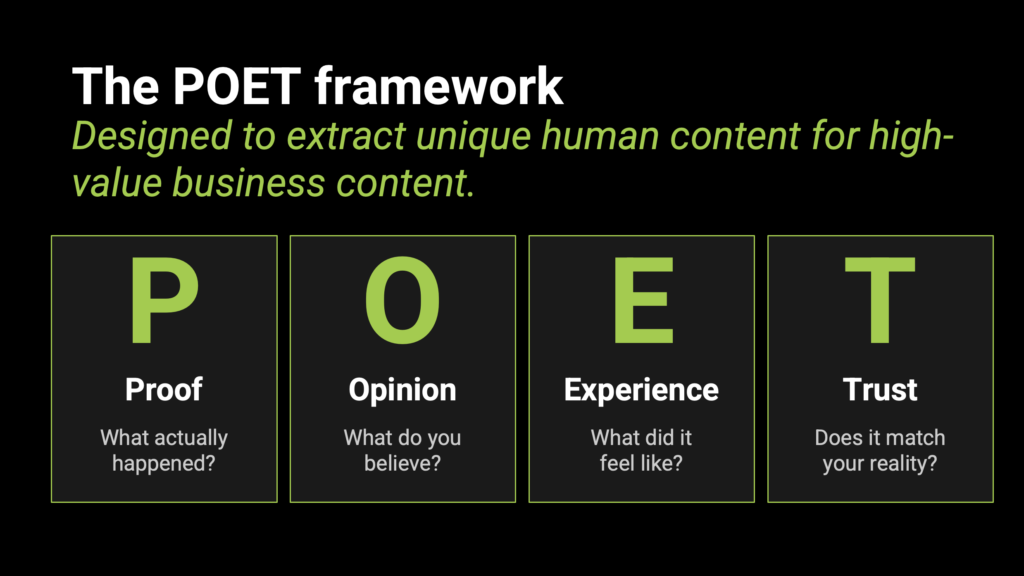
You then use those questions to interview your subject matter expert and upgrade the original content. It is a strong way to make existing content more useful, more SEO friendly, and more visible in AI search.
The Habits That Create Noise
A few common AI habits cancel out everything above. Clean writing can still be low value when it is vague, safe, and broad.
Stop doing these if you want quality to rise:
- Prompting AI with vague requests like “write thought leadership”
- Publishing trend summaries with no viewpoint
- Writing tips that would apply to any company
- Repurposing weak content into more weak content
Here is what to do instead, especially for business content:
- Start from one real customer or sales moment.
- Answer one buyer question.
- State one clear viewpoint.
- Use AI to turn that one strong core into multiple formats.
Start With One Piece
Here is the formula one more time.
Context + human viewpoints + AI for framing, optimization, and clarity = quality content at scale.
You can start with a single piece of existing content that needs improvement. If you have a published article that was weak or AI written, paste its URL into the POET tool at contentmonsta.com/poet and use the questions to pull real proof, opinion, experience, and trust from your subject matter experts.
Once you have that, AI becomes a multiplier instead of a shortcut.
- Why AI Use Should Start With Examining Operational Drag, Not Tools
- How to Reach Both Content Quality and Quantity Using AI
- Generic Content Is Dead: How to Get Unique Content From Your Experts
- The Make It Pretty Department: Why Sales Ignores Your Marketing Content
- Forward Deployed Engineer (FDE): The New AI Operations Role