
Marketing teams across B2B are hearing the same questions from leadership, from sales, and from their own teams. The questions are different depending on the role, but they all point in the same direction: content needs to connect to revenue.
After working with revenue teams across industries, I’ve identified six questions that keep surfacing. They come from CMOs, VPs of Marketing, content leaders, and digital managers. Each one reveals a gap that most marketing organizations are struggling to close.
They create content, but lack the discipline of operationalizing the process with business goals in mind, rather than marketing goals. Content Operations must explain its value in the structure of a company who’s goal is Revenue. We understand RevOps (Revenue Operations), so now let’s get a clear understanding of how to connect Content to Revenue.
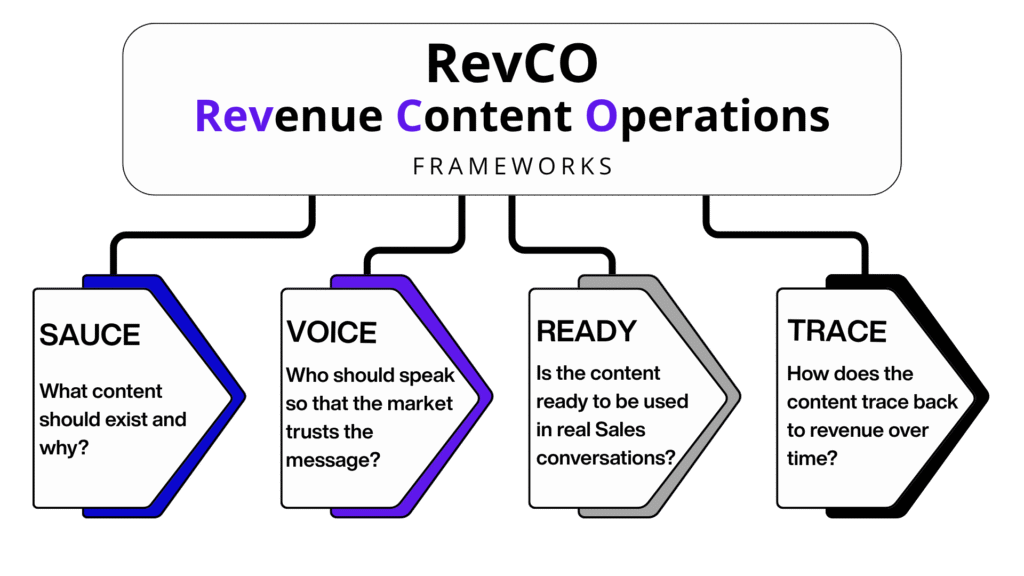
The good news is that these gaps have structural answers. RevCO, which stands for Revenue Content Operations, is a model created to help marketing teams operate content as revenue infrastructure. RevCo consists of four components with specific purposes:
- SAUCE, for content engine design
- VOICE, for authority and credibility
- READY, for sales enablement usability
- TRACE, for executive revenue influence alignment
Each one addresses a specific breakdown in how content gets planned, created, used, and measured.
Here are the six questions, and how RevCO answers each one.
“What content is actually used by sales during real buyer conversations?”
VPs of Marketing ask questions like this because they feel a disconnect between content creation and its usefulness to Sales. Marketing creates content, and either Sales ignores it or seems unaware of its existence. Then Sales struggles to communicate during deal negotiation and ends up creating their own materials – often with different messaging. Sales complains about a lack of marketing support, and the cycle repeats.
Implementing the SAUCE framework provides a pathway to answering this question and avoiding the disconnect. Following SAUCE before content creation starts puts your marketing team on the right path to creating meaningful, widely used content.
SAUCE stands for:
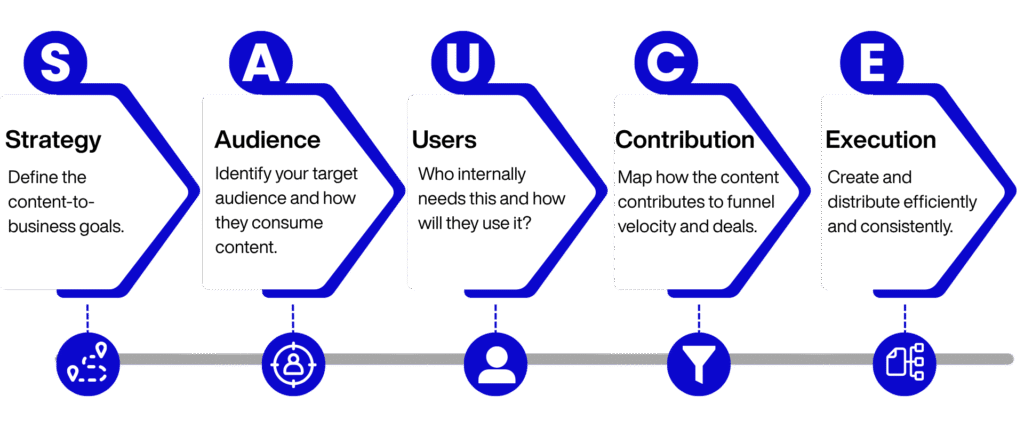
- Strategy – what strategic priority does this content support?
- Audience – who is this for, and where do they consume content?
- Users – who internally will use this content, and how?
- Contribution – how does the content contribute to business progress and revenue?
- Execution – how will it be created, distributed, and reused consistently?
The “Users” component is critical here. When Sales isn’t included in the content planning process, they have no reason to trust the output. If you want sales to use marketing content, you have to involve them before the content is created. SAUCE builds that into the planning stage so content doesn’t become a marketing-only exercise.
“How do we reduce content creation time while increasing usefulness?”
This is a resource question, and it’s a fair one. Marketing teams are stretched thin. Producing the right content is just as important as producing more content. (Note: for those thinking that “more” content is not needed – don’t make the mistake of listening to those who already have a surplus of content – you probably aren’t at a level to not need more yet.)
SAUCE handles the front end of this. Before anything gets produced, SAUCE asks five questions:
- What strategic priority does this support?
- Who is this for?
- Who will use it internally?
- How does it contribute to business progress?
- How will it be created and distributed?
When you answer those questions before production starts, you eliminate content that doesn’t have a clear purpose. You stop making things because someone had an idea or because a calendar slot needed to be filled. That discipline saves time and increases the usefulness of everything you produce, which means your content volume grows with intention behind it.
“Which content directly supports deal progression and close rates?”
This question about revenue content operations comes from CMOs, and it’s the right one to ask. The problem is that most marketing teams can’t answer it because their content wasn’t built with deal progression in mind. It was built to boost marketing metrics rather than business metrics.
This is where the READY framework comes in. READY is a readiness test that every piece of content should pass before it’s published:
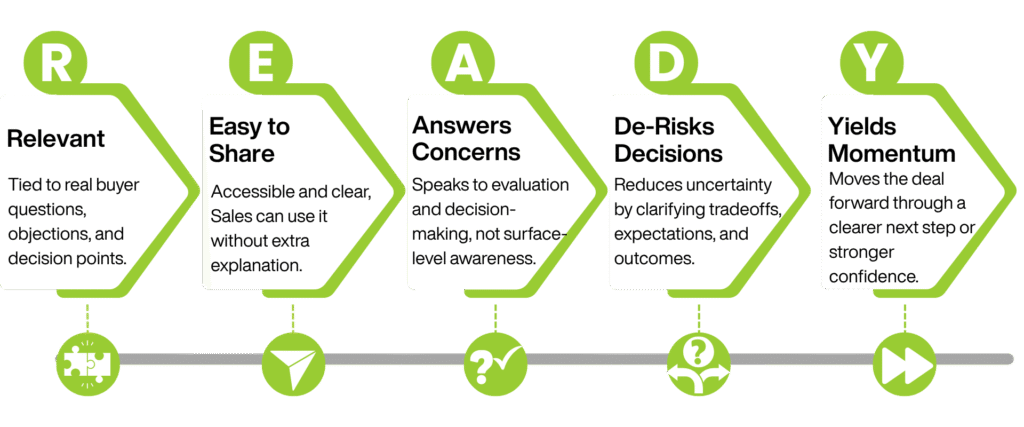
- Relevant – content must be tied to real buyer questions, objections, and decision points
- Easy to share – content must be accessible and clear so Sales can use it without extra explanation
- Answers buying-stage concerns – content needs to speak to evaluation and decision-making points
- De-risks decisions – content must serve to reduce uncertainty by clarifying tradeoffs and outcomes
- Yields momentum – content should help move the deal forward through a clearer next step or stronger confidence
Once a company has sufficient content volume, the next step is pressure-testing every asset against the reality of how your sales team actually sells. Content that passes the READY test supports deals. Content that doesn’t will sit untouched in a shared folder, no matter how polished it looks.
“How do we consistently capture expert insight from internal teams?”
Heads of Content Marketing wrestle with this one constantly. The people who know the most, your executives, your subject matter experts, and your product creators, are usually the busiest. Getting their insight into content feels like pulling teeth. These people have experiences and knowledge that no marketers, blog writer, or AI could write with quality. (Here is a free tool to help with this.)
The VOICE framework guides you in structurally examining your content to ensure it delivers the highest and most unique value. It will quickly separate the fluff and thin AI content from the best content for helping move business forward.
VOICE focuses on building authoritative content through the right people:
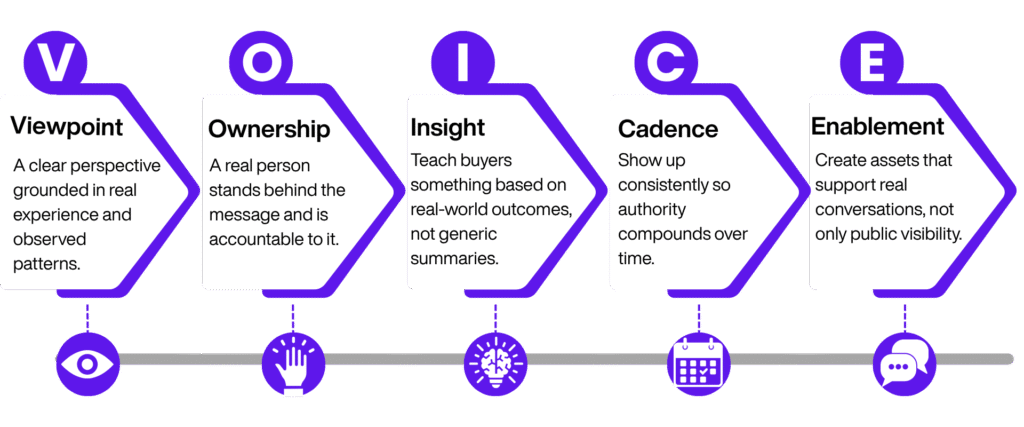
- Viewpoint, a clear perspective grounded in real experience and observed patterns
- Ownership, a real person stands behind the message and is accountable to it
- Insight, teach buyers something based on real-world outcomes
- Cadence, show up consistently so authority compounds over time
- Enablement, create assets that support real conversations
When you have a system for regularly capturing expert insight, you stop relying on one-off requests. The content gets better because it carries real experience, and sales actually wants to use it because it sounds like the experts they trust.
“What makes content credible enough to be used by sales?”
This is one of the most practical questions a content leader can ask. Sales reps won’t share content they don’t believe in. If the content feels generic, or if it reads like marketing fluff, it stays in the folder.
VOICE addresses this directly. Credibility comes from:
- Who is behind the content? The creators, executives, and experts who are the closest to it.
- What perspective do they bring based on real experience? Sales knows that the content comes from people who truly understand both the product and the business goals – not just a marketing goal.
- How consistently they show up with that perspective. When authorities show up regularly with the same message, trust is built not only with the customer, but also with the Sales team that must repeat that message.
If your content features real experts with original insight, sales reps are more likely to send it to a prospect. If your content sounds like it could have come soley from AI or from any company in your industry, it won’t survive a real sales conversation.
Building authority into your content means featuring the people who have earned credibility through experience, then structuring their insight so it’s unique and usable across the revenue cycle.
“How do we track content influence during long deal cycles?”
Marketing Directors ask this because traditional metrics fall apart in B2B. A blog post might influence a deal that closes six months later. A podcast episode or YouTube video might be the reason a prospect agreed to a meeting. None of that shows up in a standard attribution report.
TRACE was built to explain content influence inside the reality that tracking is nearly non-existent. TRACE gives you a way to explain content’s cumulative influence to leadership without pretending there’s a straight line from a single asset to a closed deal:
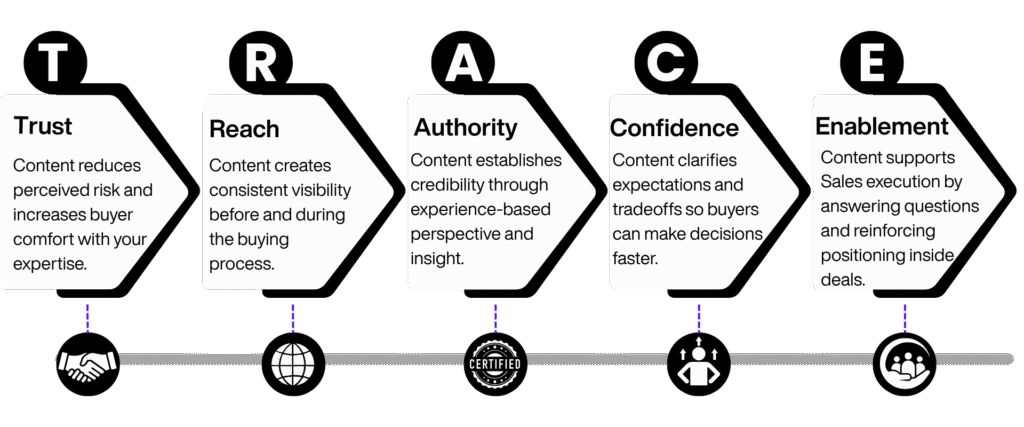
- Trust – content serves to reduce perceived risk and increases buyer comfort with your expertise
- Reach – content creates consistent visibility before and during the buying process
- Authority – content establishes credibility through experience-based perspective and insight
- Confidence – content clarifies expectations and tradeoffs so buyers can make decisions faster
- Enablement – content supports Sales execution by answering questions and reinforcing positioning inside deals
When leadership understands these five layers, content becomes a fundable asset instead of an expense that’s always under scrutiny.
The most important takeaway here is that TRACE explains why you are creating an asset, rather than waiting to measure whether it is an asset. You assert that it is an asset and its existence is the ROI.
To be clear, you can create content that is not an asset. That has historically been an issue for marketing. However, if you only build content that passes through the TRACE framework and also the READY framework, then your content is born as an asset without the need to waste time trying to track ROI down the line.
The Connecting Thread
Every one of these questions points to the same underlying issue. Too often, companies create content without a system that connects it to revenue outcomes. They create “marketing” content without formulating it as business content delivered by the Marketing department. When business content is delivered operationally by the Marketing department with the goal if influencing revenue, you’ve reached Revenue Content Operations.
RevCO – Revenue Content Operations consists of the frameworks that guide you to easily fund and prove the value of.
- SAUCE ensures content is justified before it’s produced
- VOICE ensures it carries authority and differentiation
- READY ensures it works in live sales situations
- TRACE explains its cumulative influence to leadership
When these four components work together, marketing stops operating content as campaign output and starts operating it as revenue infrastructure. When you lead with this structure, you reduce the concerns and questions that business leaders confront Marketing with. For the questions that don’t go away, you now have answers and a repeatable system to improve your operations and move your marketing efforts from being questionable to being essential.
If your team is hearing these questions and struggling to respond, the gap isn’t effort. Its structure. Build the structure, and the answers begin to precede the questions.